The Half-Job Era in Growth Teams
Rubin
Founder, GrowthGPT
For years, growth followed one default assumption: If you want to scale, split the team.
Media buyer, creative, analyst, attribution, growth PM — specialization all the way down. Every problem could be solved by adding a specific role to the pipeline.
But over the last two years, something worth naming is happening.
Growth isn't less important. Growth teams aren't going away. But the work that used to require a full, dedicated role is getting compressed into what is essentially half a job.
The Anatomy of a "Half-Job"
Over the past year, talking to growth leads, founders, and paid acquisition heads across markets, I kept hearing the exact same thing.
Teams didn't suddenly get smarter. But the work that used to need multi-person coordination now only needs a few people to: judge, orchestrate, and catch the edge cases.
Look at the three stacked shifts happening right now:
- Media Buying: Platforms absorbed execution. Advantage+, PMax, and TikTok's auto-bidding ate the manual optimization.
- Creative: Production velocity and scale got entirely rewritten by Generative AI.
- Analytics: The most mechanical parts of the SQL grind got compressed by LLMs.
Each shift alone looks modest.
But stacked together, the result isn't "this role got more efficient." It's that the role itself no longer needs to exist in its full, traditional form. It becomes half a job.
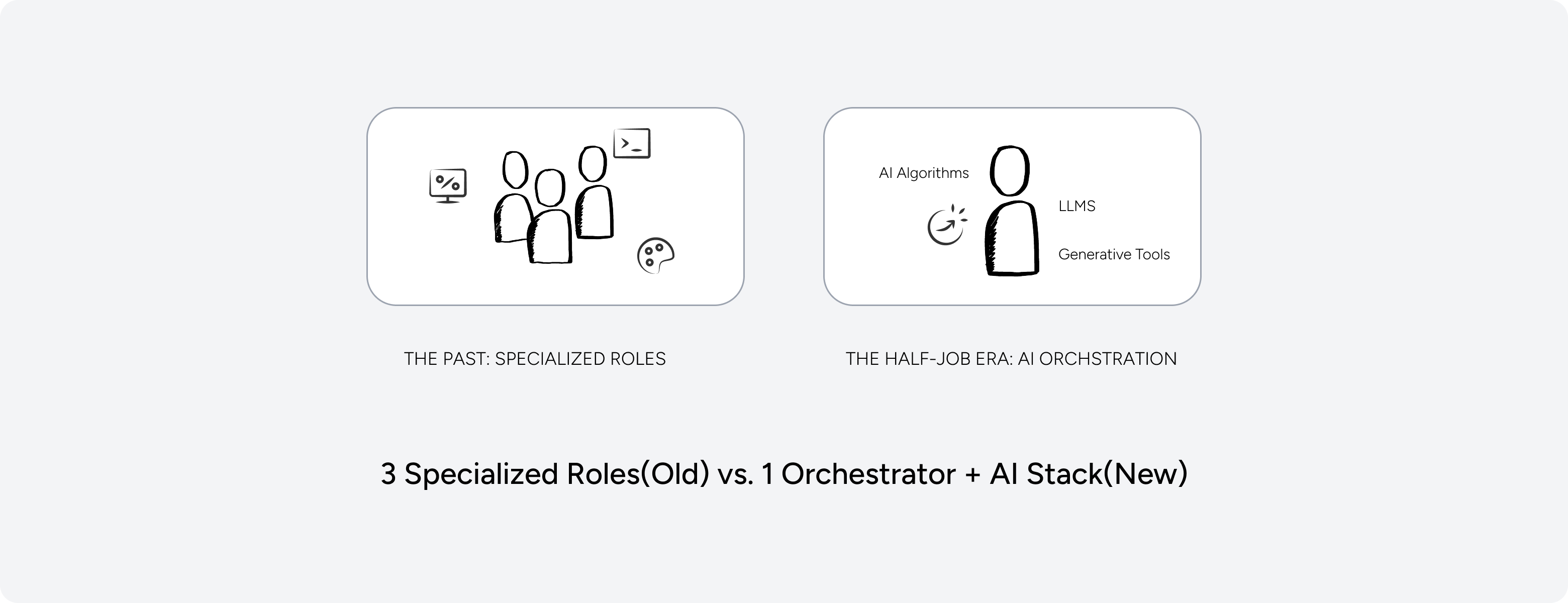
The Trap: Organizational Mismatch
The hardest part of the Half-Job Era isn't layoffs. It's organizational mismatch.
Companies know how to manage full-time roles. They know how to manage outsourced work.
What they don't know is how to manage a role where half is done by systems, and half is done by a human whose value isn't output volume — it's judgment, orchestration, and being the ultimate backstop.
This creates three immediate consequences for scaling startups:
- Role definitions blur. Senior titles can't cleanly absorb this weird new scope. The HR playbook is blank.
- Institutional memory turns fragile. Lose one agent-fluent operator, and you lose their tacit system judgment with them. This kind of knowledge doesn't transfer through standard SOPs.
- Hidden fragility. The team looks leaner on the surface, but runs on a terrifyingly deep dependency on a few key nodes underneath.
The New Logic of Growth
The new growth team isn't just a smaller version of the old one. The fundamental operating system has changed.
It is now a few core people sitting on top of agents, automated workflows, and platform capabilities, recomposing work that used to run linearly across many roles.
Scaffolding for the Half-Job Era
So the real question for founders and growth leaders isn't "will the team shrink?"
It's: when it does, do you have the infrastructure so your few key nodes aren't running on individual heroics? How do you codify their judgment into process, configuration, and reusable capability?
That's the exact direction I care about with GrowthGPT.
We are not building tools to automate a role away. We are giving these new, ultra-lean growth teams a way to codify judgment, orchestration, and collaboration — instead of loading everything onto the shoulders of a handful of individuals.
If you're in the middle of this transition, the mess you're feeling isn't a sign you're doing it wrong.
More likely: what you're managing is simply no longer the growth team of the old era. And what it needs isn't just more people. It needs a different kind of scaffolding.
See it in action.
Watch GrowthGPT run a live campaign optimization — from diagnosis to execution.
© 2026